Tuesday, August 18, 2015

Population Distribution & GDP


Eleven states and two federal territories are located on the Malay Peninsula, collectively called Peninsular Malaysia (Semenanjung Malaysia) or West Malaysia. Two states are on the island of Borneo, and the remaining one federal territory consists of islands offshore of Borneo; they are collectively referred to asEast Malaysia or Malaysian Borneo.
FlagEmblemState/Federal TerritoryCapitalRoyal CapitalPopulation[1]Total Area (km²)[2]Population density (per km²)[2]Licence plate prefixPhone area codeAbbreviationISOFIPSPartHead of state
Flag of Kuala Lumpur
Seal of Kuala Lumpur
Federal Territoryof Kuala LumpurKuala Lumpur-1,627,1722436696W03KULMY-14Peninsular Malaysia-
Flag of Labuan
Seal of Labuan
Federal Territoryof LabuanVictoria-85,27291937L087LBNMY-15MY15East Malaysia-
Flag of Putrajaya
Seal of Putrajaya
Federal Territoryof PutrajayaPutrajaya-67,964491387Putrajaya03PJYMY-16Peninsular Malaysia-
Flag of Johor
Coat of arms of Johor
Johor Darul Ta'zimJohor BahruMuar3,233,43419,210168J07, 06 (Muar &Ledang)JHRMY-01MY01Peninsular MalaysiaSultan
Flag of Kedah
Coat of arms of Kedah
Kedah Darul AmanAlor SetarAnak Bukit1,890,0989,500199K04KDHMY-02MY02Peninsular MalaysiaSultan
Flag of Kelantan
Coat of arms of Kelantan
Kelantan Darul NaimKota BharuKota Bharu1,459,99415,09997D09KTNMY-03MY03Peninsular MalaysiaSultan
Flag of Malacca
Coat of arms of Malacca
MalaccaMalacca City-788,7061,664474M06MLKMY-04MY04Peninsular MalaysiaYang di-Pertua Negeri(Governor)
Flag of Negeri Sembilan
Coat of arms of Negeri Sembilan
Negeri Sembilan Darul KhususSerembanSeri Menanti997,0716,686149N06NSNMY-05MY05Peninsular MalaysiaYamtuan Besar(Yang di-Pertuan Besar)
Flag of Pahang
Coat of arms of Pahang
Pahang Darul MakmurKuantanPekan1,443,36536,13740C09, 03 (Genting), 05 (Cameron)PHGMY-06MY06Peninsular MalaysiaSultan
Flag of Perak
Coat of arms of Perak
Perak Darul RidzuanIpohKuala Kangsar2,258,42821,035107A05PRKMY-08MY07Peninsular MalaysiaSultan
Flag of Perlis
Coat of arms of Perlis
Perlis Indera KayanganKangarArau227,025821277R04PLSMY-09MY08Peninsular MalaysiaRaja
Flag of Penang
Coat of arms of Penang
PenangGeorge Town-1,520,1431,0481451P04PNGMY-07MY09Peninsular MalaysiaYang di-Pertua Negeri(Governor)
Flag of Sabah
Coat of arms of Sabah
SabahKota Kinabalu-3,120,04073,63142S087-089SBHMY-12MY16East MalaysiaYang di-Pertua Negeri(Governor)
Flag of Sarawak
Coat of arms of Sarawak
SarawakKuching-2,420,009124,45019Q081-086SWKMY-13MY11East MalaysiaYang di-Pertua Negeri(Governor)
Flag of Selangor
Coat of arms of Selangor
Selangor Darul EhsanShah AlamKlang5,411,3248,104668B03SGRMY-10MY12Peninsular MalaysiaSultan
Flag of Terengganu
Coat of arms of Terengganu
Terengganu Darul ImanKuala TerengganuKuala Terengganu1,015,77613,03578T09TRGMY-11MY13Peninsular MalaysiaSultan


2012
Rank
State or
federal territory
2012 GSP
(RMBillion)
2011 GSP
(RMBillion)
2010 GSP
(RMBillion)
2009 GSP
(RMBillion)
2008 GSP
(RMBillion)
2007 GSP
(RMBillion)
2006 GSP
(RMBillion)
2005 GSP
(RMBillion)
1 Selangor176.239164.605155.739139.237139.877128.169118.819113.185
2 Kuala Lumpur114.106106.47797.83088.48885.41478.30271.89467.017
3 Sarawak71.87470.82166.94764.17365.47065.28360.26557.700
4 Johor68.79164.56660.67955.26856.99054.68552.53950.058
5 Penang52.53050.02748.16143.62648.74946.22643.40139.186
6 Sabah44.43442.66442.10140.98639.11435.31834.22132.427
7 Perak39.62736.98534.57632.70033.06031.04829.55827.733
8 Pahang30.75029.18727.48426.20326.46525.20624.69323.061
9 Negeri Sembilan27.71726.40725.17723.80423.65722.68021.55419.736
10 Kedah25.30723.86321.99821.09221.20921.03319.25517.829
11 Malacca21.95320.48219.68918.47218.25017.42216.33315.049
12 Terengganu19.62718.96818.48717.72018.50018.12216.86715.562
13 Kelantan13.46112.77111.99111.43611.20310.4829.6589.031
14 Perlis3.5353.3823.3183.1663.2503.1572.9452.845
15 Labuan3.1813.0072.6462.4862.3692.6782.5512.146


State or
federal territory
GDP per capita
(RM)
GSP per capita
(US$)
 Kuala Lumpur79,75224,963
 Labuan43,84813,724
 Sarawak41,11512,869
 Penang38,35612,005
 Selangor37,85111,847
 Malacca34,10910,676
 Negeri Sembilan33,03310,339
 Pahang26,7598,375
 Johor25,3027,919
 Terengganu23,2857,288
 Perak21,1506,620
 Sabah18,6035,822
 Perlis18,5195,796
 Kedah16,3165,107
 Kelantan10,6773,341


https://en.wikipedia.org/wiki/List_of_Malaysian_states_by_GDP


As of the last census(2010), the


Sarawak

 state population was 2,420,009.

The administrative capital is Kuching, which has a population of 700,000

Miri(pop. 350,000), Sibu (pop. 257,000) and  Bintulu (pop. 200,000).


Due to the large area of Sarawak, it has the lowest population density in Malaysia, which stands at 22 people per km2. Sarawak also has some of the lowest population growth in Malaysia.


Sarawak has more than 40 sub-ethnic groups, each with its own distinct language, culture and lifestyle. Cities and larger towns are populated predominantly by MalaysMelanausChineseIndians, and a smaller percentage of Ibans andBidayuhs who have migrated from their home villages to look for employment.

Ethnic groups in Sarawak[29]EthnicPercentage
Iban
  
29%Chinese
  
24%Malay
  
23%Bidayuh
  
8%Melanau
  
6%Orang Ulu
  
5%Others
  
5%

The large majority of Ibans practise Christianity. However, like most other ethnic groups in Sarawak, they still observe many of their traditional rituals and beliefs. Sarawak celebrates colourful festivals such as the generic Gawai Dayak (Harvest Festival), Gawai Kenyalang (Hornbill Festival), Gawai Burong (Bird Festival), Gawai Tuah (Luck Festival), Gawai Pangkong Tiang (House Post Banging Festival), Gawai Tajau (Jar Festival), Gawai Sakit (Healing Festival) and Gawai Antu (festival of the dead).

 Sarawak has six major ethnic groups namely IbanChineseMalayBidayuhMelanau, and Orang Ulu.[30] Several minor ethnic groups include KedayanJavaneseBugisMurut, and Indian


The Sarawak Chinese belong to a wide range of dialect groups, the most significant beingCantoneseFoochowHakkaHokkienTeochewHainanese, and Puxian Min. The Chinese maintain their ethnic heritage and culture and celebrate all the major cultural festivals, most notably the Chinese New Year and the Hungry Ghost Festival. The Sarawak Chinese are predominantly Buddhists.

https://en.wikipedia.org/wiki/Sarawak


Religion in Sarawak – 2010 Census[37]ReligionPercent

Christianity
  
44.0%Islam
  
30.0%Buddhism
  
13.5%Chinese Ethnic Religion
  
6.0%Other
  
3.1%No religion
  
2.6%


Sarawak is the only state in Malaysia where Christians outnumber Muslims. Major Christian denominations in Sarawak are the Roman CatholicsAnglicansMethodistsBorneo Evangelical Mission (BEM or Sidang Injil Borneo, S.I.B.), and Baptists. Many Sarawakian Christians are non-MalayBumiputera, ranging from IbanBidayuhOrang Ulu and Melanau.


Azlan Man

https://en.wikipedia.org/wiki/Azlan_Man


Dato' Seri Azlan Man (born 2 September 1958) is the seventh and current Menteri Besar ofPerlis, and the member of the Perlis State Legislative Assembly for Pauh. A career diplomat, he entered politics at the 2013 election, and became the Chief Minister in May that year. 

Azlan graduated from the University of Denverwith a degree in international economics, before joining Malaysia's diplomatic corps. His diplomatic posts included an appointment in 1999 as Malaysia's Permanent Mission Counsellor to the United Nations.[1][2] In 2011 he was appointed the Deputy Director of the Public Complaints Bureau.[3] He left Malaysia's public service in 2013 to return to his home state of Perlis and contest the state assemblyseat of Pauh. He won the election and was immediately appointed as the state's Menteri Besar (Chief Minister)


Image result for Azlan Man

https://youtu.be/Lz1Ug9ZJc0k

Ahmad Yaakob

Dato' Ahmad Yaakob (born 1 February 1950) is the current Menteri Besar of Kelantan.


https://en.wikipedia.org/wiki/Ahmad_Yaakob


Image result for Ahmad Yaakob

Ahmad was born at Berangan Village, Tumpat, Kelantan, on 1 February 1950. His father, Yakob Ishak, is an Islamic figure and an activist of Pan-Malaysian Islamic Party (PAS) at his village. His mother, Cik Zainab Cik Hussin, is also a PAS activist.
Ahmad married with a teacher, Siti Zubaidah Abdul Hamid, in 1980 and blessed with 11 children.


Ahmad got his elementary education at Berangan Primary School and Bustanul Ariffin Islamic School, Tumpat, before he further his secondary education at Islamic Studies College in Kota Bahru. He then studied at Islamic Higher Education Centre of Kelantan, Kota Bahru; before he further his study outside Malaysia.
He got his Bachelor graduate from Al-Azhar University in Sharia in the 1970s. In 1979, he gotDiploma of Education (Arabic Language) from Ain Shams University.[2]

He started his educational service as a teacher in Dato' Bentara Dalam Secondary School,SegamatJohor, in 1980. He then taught at Dabong Secondary School, Gua Musang (1986),Pasir Mas Girls' Secondary School (1986) and Rantau Panjang Secondary School (1987).
He resigned from being a teacher in 1995 to allow him to contest in Malaysian general election, 1995.


In 1995, he was offered to contest in 9th Malaysian General Election for Pasir Pekan assembly seat. He won against BN candidate, Saupi Daud, with the majority of 2,734 votes.
On 17 May 1997, Menteri Besar Nik Abdul Aziz Nik Mat appointed him as a State Executive Councillor (EXCO) in charge of Industry, Trade, Entrepreneurial Development and Human Resources, replacing Rozali Isohak for joining United Malays National Organisation (UMNO).
After 10th Malaysian General Election, he was appointed once again as a State EXCO in charge of Housing, Local Government, Science, Technology and Environment.
In 11th Malaysian General Election, he defeated BN candidate, Mohd. Noor Yaakob, at the same assembly seat with the majority of 2,271 votes.
Ahmad was chosen as the Deputy Menteri Besar of Kelantan on 23 March 2004, replacing Abdul Halim Abdul Rahman. He then was appointed replacing Nik Abdul Aziz Nik Mat as the Menteri Besar of Kelantan on 6 May 2013.[3][4]


Ahmad Razif Abdul Rahman

Image result for Ahmad Razif Abdul Rahman

https://en.wikipedia.org/wiki/Ahmad_Razif_Abdul_Rahman

Dato' Seri Ahmad Razif Abdul Rahman (born 7 November 1965) is the 14th and current Menteri Besar (Chief Minister) of the Malaysianstate of Terengganu


Ahmad Razif, the son of a religious teacher, was raised in Terengganu. He graduated fromUniversiti Putra Malaysia with a Masters in Science and rose through the ranks of his local UMNO division.[1]


https://youtu.be/Zkpt44rd8og


Monday, August 17, 2015

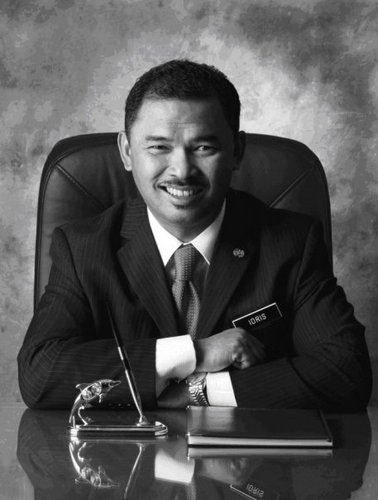
Idris Haron


https://en.wikipedia.org/wiki/Idris_Haron

Idris Haron


Datuk Seri Ir. Haji Idris Haron (born 13 May 1966[1] at AsahanMelaka) is a Malaysian politician and current Chief Minister of Melaka


Idris is married with three children. For his primary education, he went to four different schools, Sekolah Rendah Kebangsaan (SRK) Simpang Bekoh, SRK Belading, SRK Asahan from 1973 to 1977 and SRK Kubu from 1977 till 1978. He received his secondary education atSekolah Menengah Sains Muzaffar Syah(MOZAC), Melaka[3] from 1979 till 1983. At MOZAC, he became the school's best student. He later pursued his tertiary education atUniversity of Texas at El Paso and received a Bachelor of Science in Electrical Engineering .[1] His ambition was actually to become a pilot but he changed his mind to become an electrical engineer instead during interviews.
He was the Chairman of the Malaysian Student Conference until he graduated in 1989. In 1993 he participated in an intensive Japanese language training at ITM before pursuing further studies in a technical field at the Kensyu Centre in Tokyo, Japan. He has trained by the Kandenko Corporation Ltd for six months in Tokyo, Japan, in the field of electrical distribution systems. Before his election to Parliament, Idris was chairman of the Alor Gajahdistrict council.[4]


Tan Sri Datuk Patinggi Haji Adenan Satem

https://en.wikipedia.org/wiki/Adenan_Satem

Tan Sri Datuk Patinggi Haji Adenan Satem(born 27 January 1944) is

 the fifth and currentChief Minister of Sarawak.


https://youtu.be/9aoWRw6dJk8


President of Parti Pesaka Bumiputera Bersatu(PBB), which is part of the Barisan Nasionalcoalition.[4]

Image result for Chief Minister Tan Sri Adenan Satem

 He is of Malay descent.[5]  
ReligionSunni Islam

He was born in Kuching during its occupation by Japan in World War II. He received his early education at St. Joseph Primary School, and later St. Joseph Secondary School. He once worked as a journalist and teacher before continuing his studies in law at the University of Adelaide, Australia.[6] Upon graduating in 1970, he was appointed as Magistrate where he hold the position until mid-1970s.


His political career began in 1976, when he was appointed as legal advisor and a committee member of the PBB, and later in 1979, he contested and won twice, once in a by-election for the Muara Tuang Constituency in January, and again in the State Election several months later in the same constituency. And from 1979 onwards he was the Member of the Sarawak State Legislative Assembly for the Muara Tuang where he moved to Tanjung Datu for the 2006 state election,where he won. Besides than that, he is also Member of Parliament for Batang Sadong constituency after winning the 2004 election, thus he was appointed as Minister of Natural Resources and Environment.He however gave up the post in 2006,and returned to Sarawak.In 2010, he was appointed Special Advisor to the Chief Minister, and later in 2011, as Minister with Special Functions.[7]

 In conjunction with the Governor of Sarawak's 78th Birthday, he was awarded the "Datuk Patinggi" title.[8]


His other credentials are:
  • Chairman of Sarawak Foundation (since 1998)
  • Chairman of Swinburne University of Technology Sarawak Campus Council (since 2004)
  • Chairman of the Sarawak Malay Culture Foundation (Amanah Khairat Yayasan Budaya Melayu Sarawak)
  • board of directors for Sarawak Higher Education Foundation (SHEF)
  • board member of the Curtin University of Technology Sarawak Campus Miri
https://youtu.be/O5gUahTwqbI


http://www.nst.com.my/node/96115

IT is not difficult to underestimate Tan Sri Adenan Satem. Those in the know in Putrajaya are said to be unimpressed when he served a stint in the federal cabinet. They are not alone with such impression. But the Sarawak chief minister has turned such impression and perception into something of an artform, disarming critics and observers alike with his trademark nonchalance, until those who meet him get to hear him open up. This writer predicted in this column years ago that Adenan was well-placed to succeed his formidable predecessor and now Yang Dipertua Negeri Tun Abdul Taib Mahmud. Despite the inevitable rough and tumble of politics, and a serious health scare recently, Adenan made it seemingly against all odds. When Taib stepped down early last year, three candidates were in the running to succeed him and Adenan was not the obvious one. The smart money was on Datuk Abang Johari Openg. Not only was Johari the political senior as the sitting deputy president of Parti Pesaka Bumiputra Bersatu, he seemed to have the party’s support base all sewn up behind him and the tacit nod of Putrajaya. Many dismissed Adenan as Taib’s personal preferred successor simply because the former was regarded as family, being married before to a sister of Taib. But Taib did not stay as chief minister for more than three decades without the intellectual wherewithal to meticulously plan and plot almost his every political move. And, on this score, Adenan comes closest as Taib’s intellectual equal and confidante. Both went to law school in Australia and are equally well-read. A master of his brief, Adenan proved himself almost indispensable to Taib and found himself being assigned to particularly nettlesome political matters, such as Sarawak’s hugely complex and controversial native land laws. An acquaintance who admitted he had been a Johari supporter recently revealed an almost embarrassingly admiring approval of Adenan’s performance as chief minister. He has been pushing all the right buttons in his pronouncements on almost all the key issues of concern to the people, striking a chord with audiences with light banter that betrays a man very much in tune with everyday concerns despite his seemingly calculated remote demeanour of someone lost in his own world. That he mixes his speeches with flourishes in Sarawak Malay, Iban and Chinese dialect endears him to the rainbow state that is Sarawak. Important visitors meeting with the chief minister are often initially nonplussed by his seeming inattentiveness, when what is actually happening is Adenan letting his visitors have their say while he makes mental notes of everything being said. The surprise comes when it is his turn to have his say in response, done with the authority of someone clearly in command of all the nitty-gritty of state policies. Few come away unimpressed. Adenan clearly relishes his moment at the pinnacle of the state leadership. He would have been buoyed by a recent poll that revealed he enjoys general approval ratings in the mid-70 percentage range. Even the most sceptical of the voter segment — the Chinese — gave him a 60 per cent approval rating. A personally self-assured and confident Adenan, thus, goes into the upcoming state election for his first mandate as the state chief executive under favourable circumstances any politician will die for. The Sarawak Barisan Nasional romping home with another two-thirds majority in the Sarawak assembly is never in much of a doubt. The question is whether Adenan can convert his high personal approval ratings even among the state’s Chinese voters into actually winning back urban seats mostly lost to the opposition the last time around. This will not be easy, given the apparent disarray in the Sarawak United People’s Party (SUPP) that led to a splinter party called the United People’s Party that acts like an internal rival to SUPP for the affection of Chinese voters within the governing state coalition. Adenan will undoubtedly do his utmost to win not just the hearts, but the votes, of Chinese voters. His actions in clamping down on abuses in important sectors of the state economy are noteworthy and will be duly assessed by the more economically-savvy Chinese voters. While impressed, difficult follow-through steps need to be taken to root out such deep-seated maladies. The chief minister, thus, makes the reasonable-sounding argument that is precisely why he needs a convincing mandate across the board, so he can follow through on the promising starts he has already made. The writer is a Kuching-based journalist

Read More : http://www.nst.com.my/node/96115